
Not being religious in any way (as you know), I have found rituals other than felling perfectly good trees and covering them in hideous lights, kissing under undergrowth, writing vacuous ugly cards, etc. to attach to the time commonly known as Christmas. I celebrate what can more accurately be described as 'Christie-mas'.
My festive ritual, chiefly undertaken during that week-that-is-unlike-any-other-week period between Christmas and new year, is a golden time of indulgence when I become Amber Margaret, Festive Detective. I can do and have done this variously: on a beach; before a fire; under a doona; in a hammock; etc, as it basically entails me chain-reading Agatha Christie novels until I am an ageing egg-headed Belgian/nosy moth ball-smelling spinster. And? I love it. It's something I believe in wholeheartedly.
This year I devoured 3 titles, one each of Jane Marple, Hercule Poirot and one Tommy & Tuppence. 'Tommy and Tuppence? Who the hell?', I hear you ask. Reasonable question, really, since they don't get much airplay, appearing in only 4 of Christie's 66 detective novels. Unlike Marple and Poirot, however, Tommy & Tuppence age over the course of their novels. Where Poirot is consistently a retired old dude, and Miss Marple is, well, naggered from the get go, over the course of their novels Tommy & Tuppence fall in love, raise a family and then, as in By the Pricking of my Thumbs, enjoy the freedom that comes with being empty nested. It's kind of nice. Anyway, I don't really rate them as detectives and the mad old lady/daft vicar routine of this book was a bit thin, but Tommy & Tuppence and their man Albert are such a cute little unit that they kind of get away with it.
I couldn't help but feel that At Bertram's Hotel was written for tv, and that Agatha fancied filming in a kind of lush hotel location, really, but it was interesting to see Jane Marple operate in an urban setting, rather than in some far flung village/sea side location. And, as usual, she smashed it. Miss Marple for President.
Now, I've said this before, but I absolutely prefer the 'indi-Christies', featuring none of the stars of the Christie-verse, and in fact, as I said after last year's Christie-mas, Poirot is possibly my least favourite. But, when one leaves one's library going too late, sometimes one is not in a position to be selective. And Murder in Mesopotamia was actually really good. Christie trained as a nurse and an apothecary during the war and her second husband was an archaeologist and when her writing draws on these lived experiences, Christie is really at her best. Poirot was, as usual, incredibly irritating, but this was an excellent example of the lady at her craft.
But, and here we get to the scene where everyone is in the drawing room, waiting with bated breathe for the murderer to be revealed, something very unusual happened this Christie-mas. I had finished the three novels and picked up The Labours of Hercules. I hadn't appreciated this during my frenzied grab at the library, but this was a book of short stories. Shortly after I started reading, I realised there had, indeed, been a murder. I feel like the private detective who discovers her hero did it, and I didn't want to tell you. I tried to hush it up, hoping it would go away, but it's time I came clean...
Agatha Christie murdered the short story form. Brutally. With no conscience. That's right: They were shit. Epic fail. Like, possibly some of the worst short stories I've read outside the confines of a grade 9 remedial English class. I didn't finish it. I'm sorry, Agatha.
I felt a bit like I'd just opened a present from Santa and found it broken in the box. The reason I come to Agatha at this time of year is her dependability. Until now, I thought she was infallible. Safe. I believed in her. And now I find she's just human, like Santa. It's not the bike I asked for, if you know what I mean. It's an ill-fitting scratchy woollen jumper. I need to find something to wash that disappointed taste out of my mouth and hope I can repair the relationship before next Christie-mas.
Jan 29, 2012

Jan 9, 2012
Women of Letters curated by Marieke Hardy and Michaela McGuire

I secretly love this book because it’s about chicks writing to each other. And I’m a chick who loves both writing and receiving letters. And I secretly hate this book because I’m not in it and it makes me feel uncool; like somehow after 25 I gave up any bohemian ideals I might have had and grew up, instead of cultivating vagabond friends and an addiction to rollies and cask red wine. Lord knows it could have happened.
Originally conceived as a series of Sunday afternoon salons bringing together women on a variety of topics, organisers and gals about town Marieke Hardy (she of former Triple J brekkie hosting) and Michaela McGuire have bought together some of their fav women on a selection of topics, from "To my first boss" to " To the song I wish I'd written".
This book is full of carefully selected very Melbourne women (in the Catherine Deveny criteria sense of the word), from Helen Razer to Angie Hart to Missy Higgens to Joan Kirner. Many are dead-set brilliant (Celia Pacquloa take a bow for your hilarious teenage ode to gatecrashing a party; Peggy Frew on knowing when the end of a relationship is nigh; Sophie Black on being the work experience kid at New Idea; Eddie Perfect’s perfect love letter to his wife; Terri Psiakis on being inspired to be a comedian); Megan Washington’s intro describing her house in North Fitzroy taking me right back to Best St circa 2004). Some are just plain shite, and even more so considering the good and intelligent company they are keeping (Helen Razor, the angry shtick is getting very old; Anna Krien that description of crabs was way too graphic; Lindsay McDougall’s failed attempt at irony; Bhakti Puvanenthiran I don’t know who you are but your story didn’t make sense and should have been cut out).
Perhaps I could loan this to you and send a letter enclosed….now THERE'S an idea.
The Easter Parade by Richard Yates

As acerbic as drinking vinegar and sometimes as sharp as squeezing lemon juice into a papercut, Yates wrote of the Age of Anxiety – the decades (hell, the lifetimes) where women were meant to accept the social norms of family life no matter how abnormal things might be behind closed doors. He manages to hint at something that’s going rotten in suburbia, by writing the most amazing female characters. How does he get inside their heads so expertly? How does he manage to make men seem both manipulative and pathetic? Reading this is like being in a slow motion car crash – we know it’s going to end badly but we can’t stop it. “Make better choices!!” we scream at the characters, but to no avail.
Just like his earlier Revolutionary Road pulled the rug out from under the construct of the perfect marriage, The Easter Parade looks at the dysfunction of two sisters and the different paths their lives take. It’s a short book that fast forwards through 40 years; showing the optimism of the sisters’ youths through to troubled middle age where careers turn out to be just jobs and getting beaten by your husband turns into the highlight of your day, because someone pays you some attention. It’s a book heavy with sadness and a sharp reminder for women to never take life granted; before you know it, you’re the crazy old lady who used to be pretty and coulda been a contender. The writing itself is sublime – every word is used for a reason and there is something very special about reading a book this well written. It’s taken me a while but I’m very glad I found you Mr Yates.
A Heartbreaking Work of Staggering Genius by Dave Eggers

Having been blown away by two of his non-fiction works that I’ve read this year, I went back to the start of Mr Eggers writing – the modestly but completely tongue-in-cheek named AHWOSG. It’s a confusing, angry, loving and tender soup of a book that sometimes loses itself by being a bit too clever for its own good. Eggers’ struggle with the fact that he’s writing this book at all is palpable; each chapter a self-flagellating exercise. Obviously a very smart kid from a working class family that has an extremely shit run of luck, I wonder if his parents both hadn’t of died, leaving him to look after his younger brother Toph, would he have had that cataclysmic anger and misfortune to propel this book? Had they lived to a ripe old age, would he have been happier and had a more carefree life, playing Frisbee and getting drunk and stoned with his college buddies, without this burning sense of injustice? And there might be the crux: I think Eggers knows that he has “used” the experience of his parents dying as fuel for this novel’s fire, and he hates himself for it, with some chapters pummelling himself and his motivation for writing the book in the first place.
But you know what man? It’s your experience, it’s one that not much good can come of whichever way you slice and dice it, so I think your parents would be more than proud.
*Note: I read in a profile on Eggers that his sister Beth killed herself at 33. The answer to the question ‘How much heartbreak can one person take?” is still being tested. And I hope Toph is ok.
Dec 26, 2011
The Year Of Magical Thinking by Joan Didion
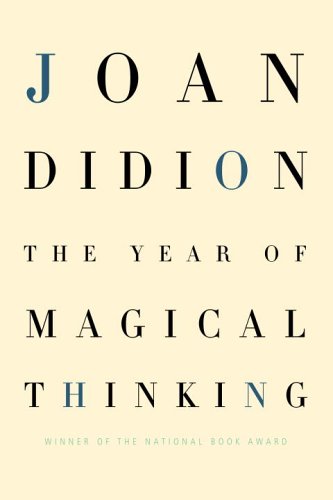 Heartbreak in a jar, pretty much. I'm not giving the game away if I tell you (since I'm pretty sure it says this in the blurb) that this is Joan Didion's account of the year following the day when, as her daughter lie in a coma, her husband died. Smack down.
Joan and her husband John appear to be some kind of Gatsby-esque caricatures - writers, living in New York, with tales of having flown between cities to have dinner together when working apart - and there's enough socialite name-dropping in this book to put some glossy magazines to shame, but this is one of the most tender accounts of a marriage I have ever read.
We can't know what it is to grieve for and mourn a spouse without having done it - a sentiment Didion herself expresses, saying:
"Grief turns out to be a place none of us know until we reach it. We anticipate (we know) that someone close to us could die, but we do not look beyond the few days or weeks that immediately follow such an imagined death."
- but I strongly suspect this is the most lucid, illuminating account of such an experience I'm likely to come across.
Cheerfully, her latest book, Blue Nights, was written following the death of her daughter, in case you're interested in a double whammy. I, for one, am going to have to let that one alone for a while...
Dec 9, 2011
A Visit from the Goon Squad by Jennifer Egan

It has been a long while since I devoured a book in a day; I can put this down to having a full time job, busy weekends and it being a rarity that a book comes along that is that good. The literary planets aligned, and I found myself splayed on the couch for many, many hours, pretending I was a uni student, or a sullen teenager. Oh those were the days Cockatoo Mobile Library!
So what is this book about? It’s about time (the title’s ‘goon’), getting older, getting wiser, getting dumber, things you did in your youth and the things you do in your old age, regrets, disappointments, with the loose framework of music linking it all back in together. There is a chapter written entirely in the form of a Powerpoint presentation, and it is a delight. You won’t believe me until you read it yourself. It has a surprising turn of phrase: "the sun felt like it had teeth". The last chapter confounded me a little – I liked what she was trying to achieve, but not sure if she quite got there. But I’ve always been a stroppy ending reader – when I read a really good book, they could end it perfectly and I’d still be grumpy that the whole enterprise was over.
Over to you Hammill…see if you agree with the Pulitzer jury.
The Happiest Refugee by Anh Do

This book won some major publishing prize this year for being one of the highest selling locally written books of the year, and while the writing is pretty basic, the story (and the humour with which it’s told) is quite extraordinary. Anh is an Australian-Vietnamese comedian, who came into the cultural lexicon via a few spots on Rove and Dancing with the Stars, which he won, and became an instant celeb (I was overseas at this time so kind of missed this crucial profile building period). But it seems that for a time, Australians were happy to embrace this Vietnamese looking, Aussie sounding guy because he was funny and non-threatening.
And this is where Anh has snuck under the radar by telling what is a really shocking and devastating boat family story, coated it in gags and Australians have lapped it up – kind of like sneaking vegetables onto the plate and making you like them without knowing you’re eating them. This is a GREAT thing, and there’s even talk of it being compulsory reading for early high schoolers. But while this book is being lauded as one of the best of 2011, we still have the Herald Sun and the Daily Telegraph howling about sending back the boats on their front pages. Go figure.
I loved Anh’s sweet and unwavering positivity, and belief that he can do anything he sets his mind to – from studying law to being a comedian to wooing his best friend from uni and having three sons, winning a bundle of money for charity on TV – there’s no idea too big or too silly to have a crack at. He’s a massive dag and there is absolutely no pretension to the writing at all. It definitely put a smile on my dial.
Subscribe to:
Posts (Atom)

 Posts
Posts

