Bringing Books to the People

Bringing Books to the People
The Book Bus

Mar 24, 2011

The Privileges by Jonathan Dee


This is totally my version of trash – well-written, interesting characters, snappy dialogue, wealthy New York backdrop that you chow through in a few days without any sense of mental indigestion after snapping it shut and promptly forgetting about it. (In fact, the ending of this book made no sense at all, and was quite disappointing. But I will forgive Dee as the beginning and middle were more than satisfactory).

Centred around an annoyingly self-assured and charmed couple, Adam and Cynthia, The Privileges follows them as they rise through the elite ranks of New York society. Adam is a hedge fund manager turned criminal inside trader; Cynthia seems happy to just bathe in the light seemingly shining out of her husband’s arse. She also seems mildly insane; functioning but likely to snap at any time.

Two diametrically opposite kids (one a spoilt drug-taking princess with zero direction and the other an art school attendee trying to hide his family’s immense wealth) round out this insular quartet. Adam and Cynthia apparently run off their limitless love for each other – her reaction when he tells her that he has been scamming money for the better part of the decade is met with adoration (“you did this all for us!”) rather than anger or fear. They just believe in the power of each other, to the point of freezing out all others. It’s like they're The Untouchables.

That’s what I found kind of charming about this book – that the actions of many characters were unexpected, and almost the opposite of a normal reaction. No-one is caught, no-one is redeemed, wealth, ego and self-fullfillment are applauded. A nice change from the uber earnest Eat Pray Love set.

Never let me go by Kazou Ishiguro


I have a book dealer at work – a very switched on gal that orders 30 books on Book Depository before going on holiday, and gets through them all. She’s been giving me the good stuff for some time now; she knows my taste quite well and I trust her literary judgment. Like a good dealer, she is reliable and trustworthy.

So when she handed me this book with a reverent look in her eye, I took it to be a good sign. This book was going to be AWESOME.

But it was not to be for this little black duck. I had read Ishiguro’s When we were orphans when I was at uni, and remember being completely underwhelmed, but I swept these reservations to the side, thinking that perhaps age and maturity would allow me to read his works in a different light. Also since then I have discovered the zany, eccentric joys of Japanese writer Haruki Murakami (the most excellent The Wind-Up Bird Chronicle - remember reading this in Argentina?) so I thought I'd see if this Asian bro came up with the goods.

The blurb describes the mood of this book as ‘disquieting’ and that is certainly true. There’s this weird creepiness, and you know something odd is up, but the author never gives much away…very much of the ‘I’m going to start telling you some of this story, but the rest is for another time’ school of suspense. Which works – to a point. It’s such a slow reveal that I found by the end, I was waiting for something so much bigger, that I felt a bit cheated.

And maybe that says something about the way I view things, because the whole plot revolves around this one large ethical dilemma (I won’t give it away if you haven’t read it) that I didn’t find all that alarming or revolting. There just wasn’t enough context, or enough of the emotional side of the main characters, for me to feel they were losing out all that much.

Or maybe I’m just a cold-hearted wench…

Mar 11, 2011

Northanger Abbey Jane Austen


Jane,

Not your finest work. Few characters, little intrigue, poor attempts at Gothic parody, and a general lack of wit and insight. I know it was one of your early works, but still.

Frankly, it's no wonder the blokes who bought it off you for a tenner in 1803, decided not to print it, and sold it back to your brother for a tenner in 1817. I guess the upshot of this is that it was never in print while you were alive. This begs the question though, whether your bro was just profiteering when he had it publishing posthumously?

C -

Feb 20, 2011

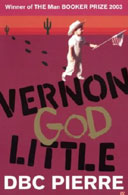
Vernon God Little DBC Pierre


I am aware that I've come to the party a little behind the times on this one, being that it won the Booker in 2003, but I'm here now, ok?

It's possible that I'd read this before (see this post, where a similar thing happened, and where I extolled the virtues of a blog such as this to protect me from this experience in the future). But that didn't actually make any difference, since I have the memory of a goldfish and was therefore just as surprised at every event and masterful turn of phrase as I suppose I must have been the first time.

In fact, if having possibly read it before wasn't enough, I'll also confess to having a seen a play of it half way through this reading (thanks Kate LeM!). Turns out even actually knowing the ending couldn't ruin the reading. That's how brilliant the writing in this book is, it wouldn't matter what he wrote, you'd read it. Guaranteed fact.

So, here's a learning I made: the thoughts and encounters of Vern, a moody, self-obsessed teenage boy in the middle of nowhere, are indeed an allegory for the modern human experience, and they are marvellous. Take this:
I sense a learning: that much dumber people than you end up in charge. Look at the way things are. I'm no fucken genius or anything, but these spazzos are in charge of my every twitch. What I'm starting to think is maybe only the dumb are safe in this world, the ones who roam with the herd, without thinking about every little thing. But see me? I have to think about every little fucken thing.

Vern is the future, and he needs some learnings. And he gets them, boy. It's not until he is literally at death's door that he learns to play the game, and, admittedly, he learns from someone who appears to have lost the game, but the wisdom this man passes onto Vern is literally what sets him free:
'Boy, you really missed the boat. I'll make it simple, so's even fuckin you can understand. Papa God growed us up till we could wear long pants; then he licensed his name to dollar bills, left some car keys on the table, and got the fuck outta town ... Don't be lookin up at no sky for help. Look down here, at us twisted dreamers.' He takes hold of my shoulders, spins me around, and punches me towards the mirror on the wall. 'You're the God. Take responsibility. Exercise your power.'
...
'Big yourself up - watch any animal for clues. As for us humans - check this ... Learn their needs, and they'll dance to any fuckin tune you play.'

Amazing. So here's another learning I made: don't wait 8 years to read a really good book, spazzo.

Feb 17, 2011

The Family Law


What a funny, funny book this was – a total unexpected gem. I’d read Benjamin Law in snippets in The Age and Frankie magazine, and this is his full-length autobiographical effort. And I’m going to make a call and see it’s almost in the Sedaris league for laugh out loud wrongness. For me, who was born in the same year as Law (1982) and found absolutely all of his pop culture and nostalgic references spot on, I couldn’t help laughing hysterically at points in the point.

Basically it’s a collection of essays on his strange but lovable family. The son of hardworking Chinese immigrants, Law grows up in Brisbane and deals with his parent’s divorce, adolescence, coming out and growing up – all with a crude yet touching sense of humour (my favourite kind). None of his trials and tribulations are anything special (he doesn’t get abused, bullied or hit by some mystery illness), he just approaches everyday things a slightly twisted outlook.

Law’s mum is particularly awesome, and there’s a section involving the term ‘vagina meat’ and another involving a family trip where they speculate on Minnie Mouse getting raped at Disneyland that sends them all into fits of laughter, that really show this family's warped sense of humour. I couldn’t get enough of it. Also the section where he remembers watching the movie IT with his older brother and “my nine year old brain almost had a stroke from the fear” was something I totally related to, having also had this same experience.

It’s interesting that Law thanks fellow writer and friend Alice Pung in his author acknowledgements, as I read her account of growing up Asian in Australia, Unpolished Gem, earlier this year. Law has managed to pull off what I think Pung would have liked to, but I think she got a bit scared of embarrassing her family and pulled back a bit, where with Law, nothing is sacred. And this book is so much better for it. It also reminded me a little of what Judith Lucy attempted to do with her Lucy Family Alphabet, but there was a bit of a sinister undertone to her writing – she came across a bit displaced by her upbringing, and you were never certain that her family acted out of love; in The Family Law, there is crassness and silliness, but love is clearly abound.

Feb 10, 2011

Monkey Grip by Helen Garner


I have attacked Garner’s catalogue backwards: from newest to oldest. This is her seminal first novel, published in 1977 and later made into a cult classic film. Based in Carlton, it’s a tale of loving people you shouldn’t and loving them anyway. I love how unapologetic Garner’s characters are in her novels, unflinching. It’s a snapshot of a place and a time, of twenty-somethings drinking brandy alexanders at the local pub for 20 cents, bed swapping and drug taking, and reminded me of my own Carlton spent uni days, which were not quite as hedonistic but filled with beer, declarations of love, general confusion and good times.

Heroin is abound and Nora’s in love with Javo, a hopeless junkie. He floats in and out of her Rathdowne St share house, ignores her at parties and goes to Hobart to dry out. Everyone is shagging and snorting up, and there’s a weird casualness to these relationships that seems foreign in today’s age of caution. Safe sex or injecting is never an issue. I highlighted this passage as it just so perfectly encapsulated a moment I’ve had more than once (substitute the wood chopping with another small household task):

“Tentatively I stood a great lump of wood on the chopping block and bought the axe down on it. It flew into two perfect halves. Such was my elation that I ran inside, put on our ancient cracked record of Aretha Franklin singing Respect and danced all by myself for half an hour in our living room, without inhibition almost crying with jubilation – not just about the wood, but because I could live competently some of the time, and because that day I liked myself.”

Perfect, honest, un-airbrushed words from a true wordsmith.

The Devil in the Kitchen by Marco Pierre White


These days, anyone who has ever made a sandwich on the telly is qualified to be a ‘celebrity chef’, but back in the 80s, it was Marco Pierre White in London who was the bad boy of the restaurant scene. His autobiography is basically a celebration of what a selfish, uncompromising, single-minded pig he was for much of the time he was running said restaurants. Being an ex-waitress, I know he’s not exaggerating when he says he worked for 18 hours straight, or put a fish down the trainee chef’s pants. I enjoyed reading about the crazy concoctions he came up with, the obscene amount of money being thrown about on restaurant bills, and his almost autistic like search for the perfect piece of cutlery for his eateries. But at the same time, he was boozing, ignoring his family and being a tyrant, which he seems to take some sort of misplaced pride in. The really interesting stuff – like what really went wrong with his venture with former friend Damien Hirst – are completely glossed over, which makes you wonder that if he wouldn’t touch that uncomfortable period in his life, what else has he avoided, or neglected to include? The temperature on this dish of a book is: tepid at best.